Medical Devices Quality Management System
Ensure Quality and Safety in Medical Devices with ISO 13485:2016 Certification!
ISO 13485:2016 is the international standard describing how to build and maintain a quality management system for medical-device activities. Its purpose is to demonstrate an organization’s ability to supply medical devices and related services that consistently meet legal and customer requirements. While it shares the process approach of ISO 9001, it includes additional rules for patient safety and regulatory compliance. The standard follows the Plan–Do–Check–Act (PDCA) model and applies risk-based thinking to every process. It can be used by any organization involved in one or more parts of a medical device’s life cycle design, production, distribution, installation, or service. Published by the International Organization for Standardization (ISO), it is recognized worldwide as a foundation for medical-device quality systems.
The framework facilitates adherence to global medical device regulations.
Risk management lessens risks associated with use or errors.
Certification shows consistent, verifiable product quality.
Defined procedures lead to predictable manufacturing outcomes.
Records link materials, components, and finished devices.
Consistent inputs are secured through approved-supplier programs
Data analysis and validation prevent recurring errors.
Teams work better together when roles are clearly defined.
Frequent audits lower the likelihood of non-conformities.
By adhering to ISO 14001:2018's regulations, it became simpler to establish connections with international markets.
Conducts sterilization validation and batch release review.
Manages incoming-material inspection and traceability logs.
Verifies label accuracy and seal integrity.
Keeps an eye on product identification and storage conditions.
Manages device testing and biocompatibility testing.
Authenticate programs used for diagnostics or monitoring.
Upholds environmental control and verification protocols.
Maintains procedures for verification and environmental control.
Provides competence development for assembly or handling.
Uses simplified forms to track processes and maintain evidence.
The quality system structures everyday activities and clarifies responsibilities. Employees understand how to complete tasks, record data, and escalate issues. Inspection and test records show that products meet specifications. Audits and analysis detect nonconformities before they reach the customer. Rather than making assumptions, management decisions are based on measured facts. Meetings across functional boundaries enhance communication between the design, production, and service departments. Delivery times become more dependable when there are fewer errors and reworks. Training and written instructions enable new hires to follow proper protocols right away. This method eventually creates a culture of quality where safety and compliance are standard operating procedures.
A: Not everywhere, but many regulators and clients require it for suppliers of medical devices.
A: Yes. The requirements can be adjusted to the size and scope of the company.
A: Procedures, Forms, risk assessments, defined scope, legal compliance and internal audit reports are examples of important records.
A: Internal audits occur on a planned schedule; certification audits are typically yearly.
A: Leadership defines policy, allocates resources, and reviews performance for effectiveness.
In medical device operations, ISO 13485:2016 provides a dependable approach to ensuring safety, uniformity, and regulatory compliance. It helps businesses protect patients and satisfy the needs of clients. When done right, it promotes trust among users, healthcare providers, and authorities. A Medical-Device Quality Management System is not only a set of forms but a working structure that connects design, manufacturing, and monitoring. Through planning, control, and continual improvement, quality becomes a shared daily responsibility. Applying ISO 13485:2016 enables any organization to produce and deliver medical devices that are safe, effective, and compliant with international requirements.
Quality Management System :
Unlock Quality Excellence with ISO 9001:2015“ Your Path to Superior Management!
Environmental Management System :
Build a Greener Tomorrow with ISO 14001:2015“ Your Guide to
Sustainable Success!
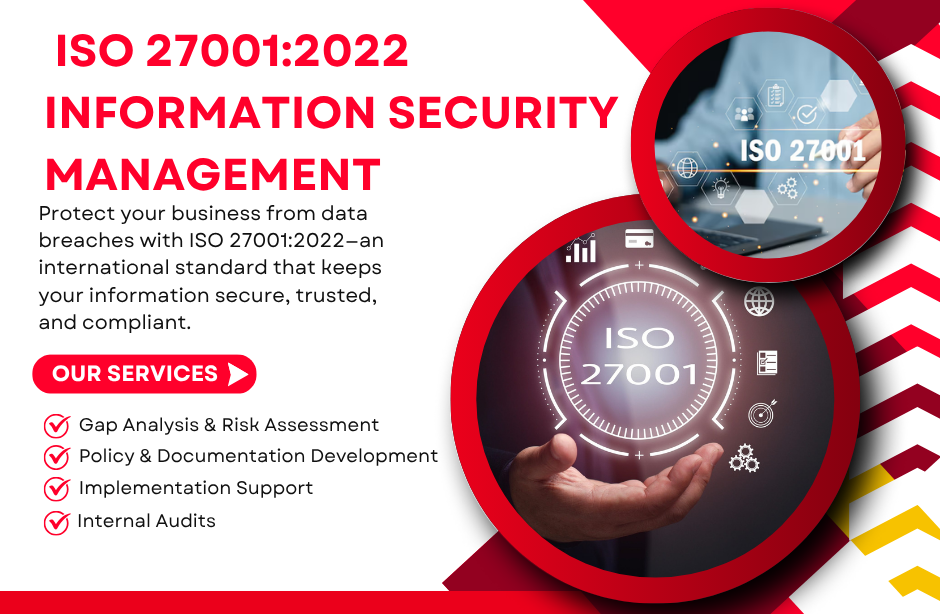
Information Security Management System (ISMS)
Secure Your Information, Secure Your Future with ISO 27001:2022!
Get in touch with our expert consultants to begin your journey to compliance and operational excellence.
Request Consultation