Food Safety Management System
Ensuring Safe Food from Farm to Fork with ISO 22000:2022 – Because Safety is Served First!

ISO 22000:2018 is a global standard that identifies the specifications of a Food Safety Management System (FSMS). It integrates the following important aspects, including interactive communication, system management, prerequisite programs (PRP), and the hazard analysis and critical control point (HACCP) principles. The standard is based on the Plan-Do-Check-Act (PDCA) model and uses the risk-based approach to everything that affects food safety. Any organization that deals in the food chain can use it: the farms, processors, packaging units, transporters, or retailers. The International Organization for Standardization (ISO) published it, making it a highly popular reference source for maintaining food-safety assurance.
Food-safety hazards are prevented and controlled in a systematic manner.
Ensures conformance with international and national food regulations.
Certification demonstrates dedication to producing safe, healthy products.
Standardized processes reduce errors and minimize variability.
Improved information flow reduces confusion across teams.
Fully compatible with ISO 9001 and ISO 14001 management systems.
Defined roles and monitoring minimize waste and rework.
Preparedness plans limit damage, delays, and operational disruption.
Regular reviews and audits drive ongoing performance enhancement.
Certification supports export opportunities and global market growth.
Controls raw materials, temperature monitoring, and sanitation programs.
Manages pasteurization parameters, hygiene, and cold-chain tracking.
Implements allergen controls, cleaning schedules, and ingredient traceability.
Validates freezing, packaging, and labeling activities.
Maintains water-quality records and sanitation of tanks and containers.
Monitors cooking, serving, and holding temperatures.
Maintains refrigerated vehicles and delivery documentation.
Ensures food-contact material safety and hygiene controls.
Monitors labeling accuracy, stock rotation, and shelf-life management.
Uses simplified HACCP forms and daily hygiene checks.
The Food Safety Management System (FSMS) streamlines day-to-day operations and clarifies responsibilities. Employees follow defined procedures for handling, cleaning, monitoring, and storage. Inspection, testing, and monitoring records provide evidence of food control at every stage. Audits highlight weaknesses early, enabling timely corrective actions before risks reach consumers. Management decisions rely on verified data rather than assumptions. Cross-department communication improves between production, procurement, maintenance, and quality teams. Fewer errors and reworks increase reliability and consistency of deliveries. Training ensures new employees understand safe food-handling practices from the first day. Over time, the FSMS builds a strong food-safety culture where compliance and hygiene become routine.
A: No, it is voluntary, but many clients and regulators require certification as proof of effective food-safety control.
A: Yes. ISO 22000 is scalable for all business sizes and complexities.
A: Key documents include hazard analysis, monitoring logs, corrective actions, verification results, and food-safety procedures.
A: Internal audits are scheduled regularly, while external audits are conducted annually.
A: Leadership sets policy, provides resources, and reviews performance for continuous improvement.
ISO 22000:2018 provides a structured, practical approach for identifying and controlling food-safety hazards throughout the food chain. It supports legal compliance, strengthens consumer confidence, and ensures safe market practices. When properly implemented, it builds trust among regulators, customers, and consumers. An FSMS is more than documentation—it's an operational framework embedded in daily activities. Through planning, control, verification, and ongoing improvement, food safety becomes a shared responsibility. Adopting ISO 22000:2018 helps organizations produce, store, and deliver food that is safe, compliant, and trusted by the market.
Quality Management System :
Unlock Quality Excellence with ISO 9001:2015“ Your Path to Superior Management!
Environmental Management System :
Build a Greener Tomorrow with ISO 14001:2015“ Your Guide to
Sustainable Success!
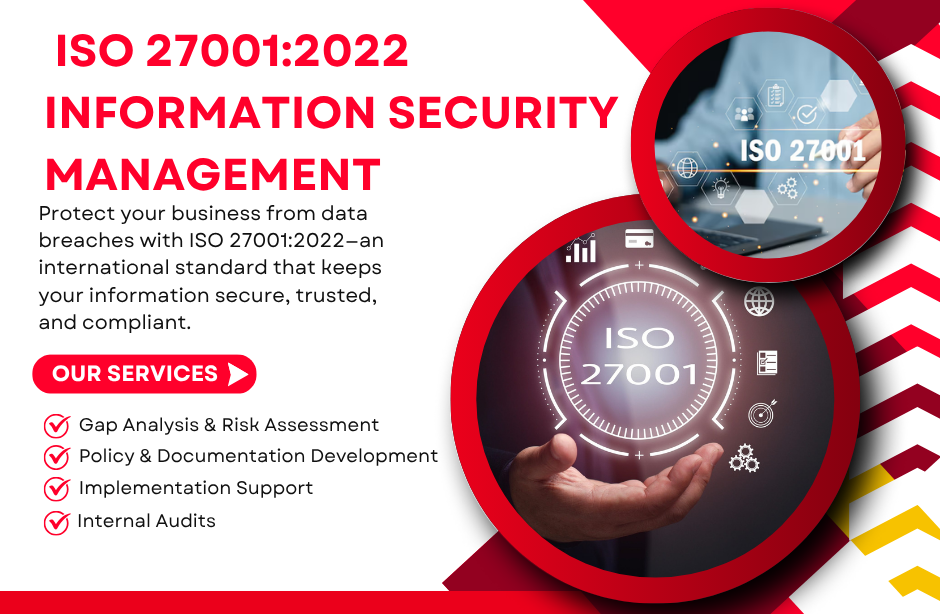
Information Security Management System (ISMS)
Secure Your Information, Secure Your Future with ISO 27001:2022!
Get in touch with our expert consultants to begin your journey to compliance and operational excellence.
Request Consultation